
Texas child support calculator / Guide
How to Calculate Child Support in Texas: A Worked Example
The father in this story is invented. The numbers are not. Every figure comes from the same calculation the Texas child support calculator on this site runs.
At 6:40 on a Tuesday morning, Marcus Reyes sat in his van outside a supply house in Round Rock with a coffee going cold in the cup holder and an email open on his phone. The subject line read Proposed child support figure. Under it was one paragraph from his ex-wife's attorney. It said his ex-wife proposed $1,250.00 a month for the two children, based on net monthly resources of $5,000.00. Mediation was Thursday of next week at ten.
He read the paragraph four times. It did not get shorter.
Marcus was thirty-eight. He fixed air conditioners for a living and could tell you what was wrong with a compressor from the other side of a wall. He could not have told you where $1,250 came from. Six years ago he had signed the first order at a lawyer's desk after reading the first page and the last page. Nobody had explained the middle, and he had never asked. Asking felt like admitting he was the kind of man who didn't know.
His chest had the tight feeling it got on a roof in July. He put the phone face down on the dash. Then he picked it up again and typed four words into the search bar, because it was 6:44, the engine was off, and the van was the only place nobody could watch him do it.
The first result was a child support calculator for Texas. It asked for net monthly income, the number of children before the court, and a few other things. He typed 5,000, the figure from the email, chose 2, and pressed the button.
$1,250.00
The same as the email. His stomach did not unclench, but something in it changed. The lawyer had not made the number up. Then he scrolled back up the form and saw a box he had skipped. Child health premium you pay, per month. He knew that one. Three hundred dollars came out of every paycheck for the kids' coverage through his employer. He typed 300 and pressed the button again.
$1,175.00
Seventy-five dollars less. He sat there with his thumb over the screen. Seventy-five dollars a month was nine hundred a year, and the only thing that had moved was a box he almost did not fill in. Under the number the page laid out its steps in five short lines. Net resources of $5,000. Minus the child's premium of $300, which left $4,700. Twenty-five percent for two children. $4,700 times 25 percent is $1,175. Next to the second line it named a section of the Family Code, 154.062. He did not know what that was either. But it was a section number, and a section number meant a person could go and check.
A truck pulled in beside him and its driver waved. Marcus waved back and did not move.
That night his daughter Lucia, nine years old, came out in her pajamas and found him at the kitchen table with a highlighter and a stack of pay stubs.
"Is that homework?"
"Grown-up homework."
"Do you get a grade?"
"Thursday." He said it lightly. It landed heavier than he meant it to, and she looked at him a second longer than a nine-year-old should have to. Then she went back to bed.
He had a lawyer, Ms. Okafor, who billed in six-minute blocks. He had not called her. Every question he could think of felt like a minute he would pay for, and half of them felt stupid. What is a premium. What is net. Who decides. He sat with the phone in his hand and his thumb on her name, and put it down again.
Instead he paid nineteen dollars for the What-If Scenario Report. It arrived as a PDF, seven pages. He read it the way he read a wiring diagram, front to back, finger on the line.
Page one gave his number again, $1,175.00, in a box at the top. Page two was a table. Each row changed one thing and left the rest alone. One more child: $1,410. And a row he had not asked for. Net income down 20 percent: $925.00.
He stopped there. In January his company was going to cut hours. Nobody had said it to him directly. It was a thing the guys said in the parking lot. Until that minute it had been a fog at the back of his head with no edges. Now it had a number on it, and the number was smaller than the one he had been carrying around. He put a small check mark beside it, which made no sense, and kept reading.
The checklist asked whether the premium was only the child's share of the cost, not the whole family plan. He dug the benefits statement out of the folder. The family plan was $410. The line for the children read $300. He highlighted it. A worksheet near the back walked him from gross pay down through Social Security tax and federal income tax, using the Attorney General's chart, to a figure at the bottom. He checked the arithmetic twice. The bottom line came to $5,000.00. It was almost disappointing. It also meant the entire gap was the $300.
The last page was a single sheet with his numbers on it and a ruled space for notes. He wrote three questions in the space with a pen from the truck. Where does the $5,000 come from. Is the premium in the $1,250. What happens to this number in January if my hours drop.
There was a second line in the email, below the figure. It said payments had been irregular.
Marcus had paid every month. He was nearly sure of it, and nearly was the word that kept him up. The page where he had downloaded the report offered a payment ledger for nine dollars, a Google Sheet, and he had added it at midnight without quite deciding to. On Sunday afternoon he sat down with the sheet on one side of the screen and his bank app on the other.
It took forty minutes. He typed in seven monthly due dates, then every payment against them: the date, the amount, the confirmation number from the bank. As he entered each one, the Schedule tab filled in by itself. Green cells that said Paid. A column that counted days after the due date, which sat at zero for most months. It showed a 2 beside July, when a transfer had posted two days late. It showed a 14 beside September, when he had sent $600 on the first and the other $650 on the fifteenth.
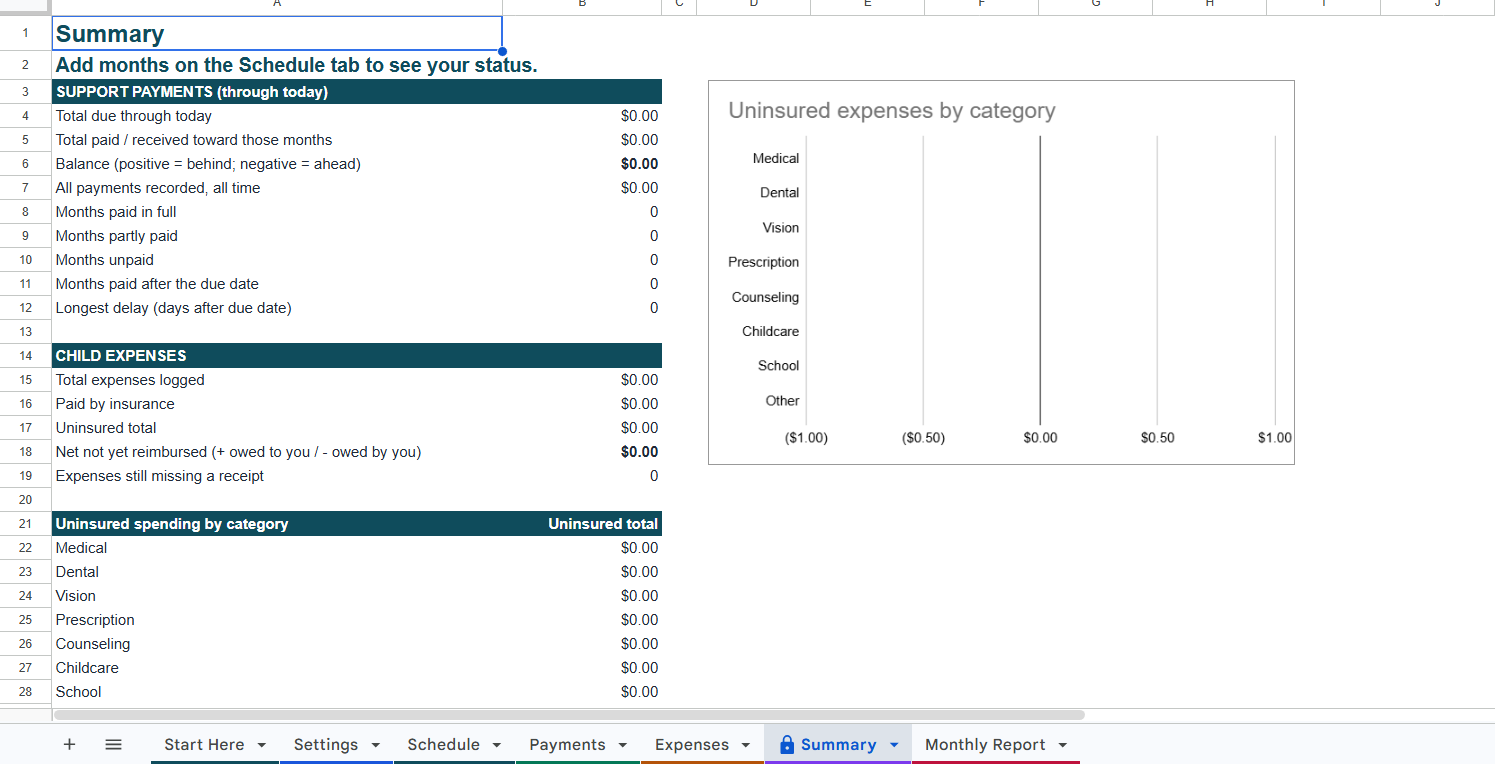
He looked at the 2 and the 14 for a while. It was not a perfect record. He had expected to feel worse. What he felt was closer to relief that the record could be checked, and that it said what had happened rather than what he was afraid had happened. Everything else was zero. Seven months, seven green cells, $8,750.00 due and $8,750.00 paid. The Summary tab said, in plain words at the top, Up to date through today.
Thursday, 9:50. The conference room had a long table, a plastic pitcher of water, and a window onto a parking lot. Marcus had worn the shirt from his cousin's wedding. His folder sat in front of him, and his right hand lay flat on top of it so no one would see it shaking.
The mediator, a gray-haired man named Pruitt, explained how the morning would go. Carla sat across from him next to her attorney. She did not look at him. He did not look at her. Her attorney slid a sheet across the table with one number circled. $1,250.00.
Marcus had rehearsed it in the van. In the van it had sounded like a man asking a question. Now, with four other people's breathing in the room, it felt like something you were not allowed to say. His mouth was dry. He heard ice shift in the pitcher. He had spent six years nodding in rooms like this one.
He opened the folder. He took out the one-page summary and set it on the table, turned so the other side could read it.
"I have a question about how this number was figured," he said. His voice came out lower than he wanted. "I get $5,000 net, and I agree with that. But I pay $300 a month for the kids' health coverage, and that comes out before the percentage. Section 154.062. So I get $1,175. Can we look at where $1,250 came from?"
Nobody said anything for what felt like a full minute and was probably four seconds. Carla's attorney picked up the sheet he had slid across, read it again, and then picked up Marcus's.
"Do you have the benefits statement showing the children's portion?"
Marcus took it out of the folder. The line was highlighted in yellow.
"I'll need to look at that," the attorney said. Pruitt wrote something on his pad.
That was all. Nothing was settled in that room before noon, and Marcus did not pretend to himself that it was. But he had said it, out loud, with his own mouth, and the ceiling had stayed where it was.
He sat in the van in the parking lot and turned the key off. For a minute he listened to nothing. The tightness in his chest had gone somewhere, and he did not know when. He opened the ledger on his phone and, in the notes column on the Payments tab, typed Thursday's date and the words mediation, asked about premium.
At home Lucia was at the kitchen table with a worksheet of her own, fractions, her tongue between her teeth.
"Is it Thursday?" she asked.
"It was Thursday."
"What was your grade?"
Marcus pulled out the chair next to hers and sat down.
"Ask me tomorrow," he said, and picked up a pencil to help her with the sevenths.
How child support is calculated in Texas, step by step
This is the same math Marcus ran. Use it with your own figures, or enter them in the Texas child support calculator and it will show every step.
- Find net resources. Start with income from all sources. Subtract Social Security taxes, federal income tax, state income tax, union dues, and mandatory retirement contributions where there is no Social Security. Then subtract the child's health or dental premium (Texas Family Code section 154.062). Marcus had $5,000 before the premium and $4,700 after it.
- Check the cap. The percentage applies only to net resources up to the cap, which is $11,700 a month as of September 1, 2025 (section 154.125; confirm the current figure in the Attorney General's Texas Register notice).
- Apply the percentage for the number of children before the court. $4,700 times 25 percent is $1,175.
- Adjust for other children you support, if any. Texas credits children in other households before applying the percentage (section 154.128).
- Add medical and dental support on top. The guideline percentage assumes health coverage is ordered in addition (sections 154.064 and 154.183).
| Children before the court | Net $1,000 or more | Net under $1,000 |
|---|---|---|
| 1 | 20% | 15% |
| 2 | 25% | 20% |
| 3 | 30% | 25% |
| 4 | 35% | 30% |
| 5 | 40% | 35% |
| 6+ | At least the 5-child amount | |
The statute is Texas Family Code chapter 154.
The Texas Attorney General's calculator and this one
The Texas Attorney General's office runs its own child support calculator, and you should check any number you plan to rely on against it. This site is independent. It is not affiliated with the Attorney General or any court. What it adds is the layer around the number: each step shown, scenarios like the ones that mattered to Marcus, and a one-page summary to bring to a mediator or attorney. The methodology and sources page lists where every rule comes from.
Texas child support for 50/50 custody
The guideline formula takes two inputs: net resources and the number of children before the court. Nights with each parent is not an input. A court can depart from the guideline when applying it would be unjust or inappropriate, and section 154.123 lists the factors it may weigh. How that works for an equal schedule in your case is a question for a lawyer.
Child support for high incomes in Texas
Above $11,700 a month in net resources, the formula stops rising. $15,000 net with three children is calculated on $11,700, which gives $3,510. A court may order more than that based on the child's proven needs (section 154.126), and that is a separate question from the guideline figure.
Run your own numbers
Marcus's gap was $75 a month, and it took one box to find. Yours may be larger, or there may be none. The quickest way to know is to enter your figures. Use net income before the child's health premium, and put the premium in its own box.
Most complete
What-If Scenario Report, $19
The report Marcus read, built from your own figures. Instant PDF download after payment.
- Scenarios for income, children and premium, ranked by what moves the number most
- The net income needed to reach a given support amount
- Worksheets for net resources and medical support limits
- A plain-English guide to Attorney General review deadlines and how payment works
- A one-page summary to hand to your mediator or attorney
Calculation Report, $9
Your inputs, every formula step, the result, a children comparison, a medical support overview, a checklist of what to confirm, documents to gather and questions for a mediator or attorney.
Payment & Expense Ledger, $9
The Google Sheet from the story. Log each support payment and each uninsured child expense, see who is ahead or behind, and print or save a monthly record as PDF.
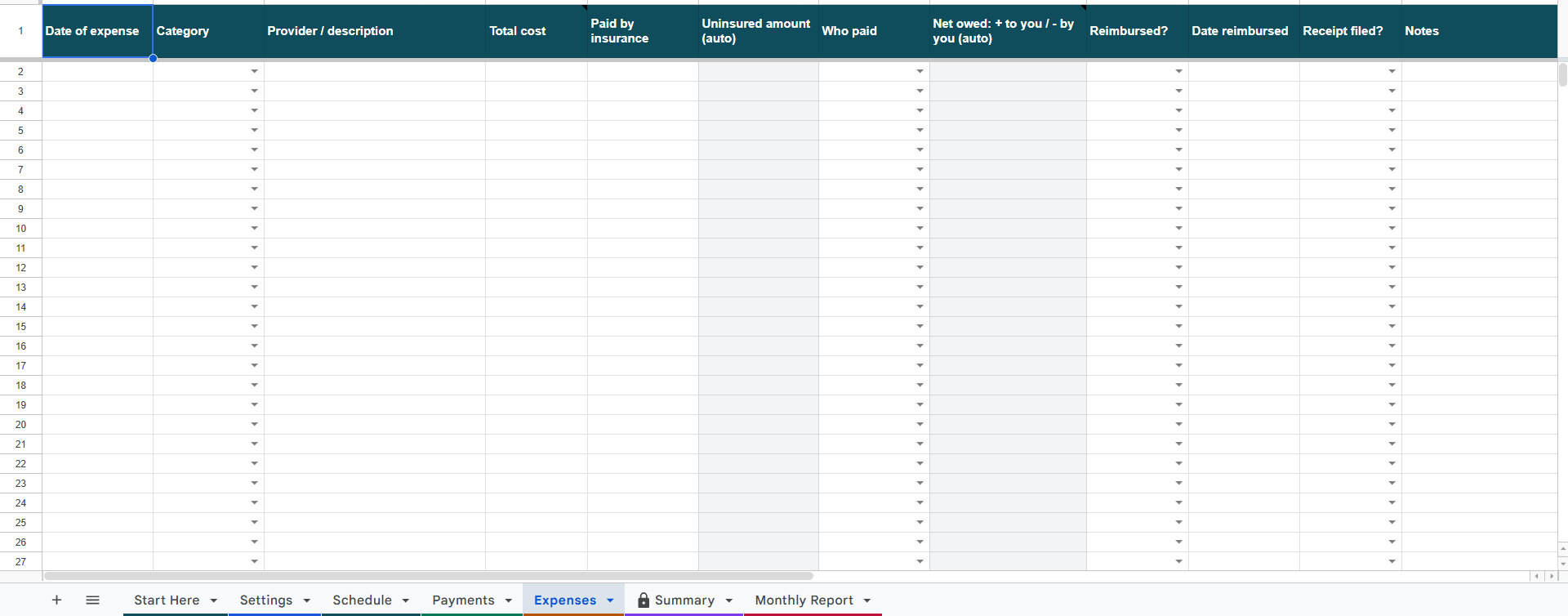
The What-If Report and the Ledger together are $24.99. Choose that option at checkout after you enter your numbers. All reports are informational estimates, not legal advice or a court order, and are not affiliated with the Texas Attorney General.